

Last Week I was in Serbia. I was invited to participate with the Bible Camp, that was organized by West Balkan Partnership, that is by the Bible Societies in the Balkans. Before I commence with the Photographic Journey of the week, I’d like to thank WBP, all the organizers, Matjaž Črnivec (General Secretary of the Bible Society of Slovenia) for inviting me and to our Lord Jesus for the amazing, awe-inspiring week. You see, there used to be many conflicts between the peoples, traditions, churches and cultures in the Balkans. Wars used to be fought over small differences of opinion. And if you’re a Christian, you’ve probably heard a multitude of reasons for the supremacy of your christian tradition, and for the heretical nature of the traditions of the other denominations. I say this because this last week people there were from various countries in the Balkans (Slovenia, Croatia, Serbia, Bosnia, Macedonia, Albania, …) and from various denominations (Catholics, Evangelicals, Methodist, Orthodox, other Protestant, …) and not once was there any anger, hatred, bigotry, bitterness or any of the vices among us. Despite our different backgrounds we were indeed one in Christ.
By saying this I don’t mean, that there were no discussions on the differences, because there were. But they were always framed around trying to understand, not around trying to impose. So let me give an example. With the guys from the Orthodox tradition we were talking about the Holy Communion. It was quite interesting when they asked the question of what do we, protestants believe on the topic of whether Christ is there in the bread and wine is spiritually blood, as their (and Catholic) tradition teaches in their doctrine of transubstantiation. I’ve encountered these kinds of questions before and I think it’s a wrong question. So I did not answer the question in the typical protestant way (since most protestants don’t believe in the doctrine of transubstantiation), but rather in a different way. The way that the question is framed it looks on the collective organization instead of on individuals and I believe that by looking at a group-think one denies individual responsibility and individual faith. And so the answer I gave was something in the lines of this: “it’s not about what protestants believe. I know it’s important to you but my question to you is, how does God see your faith in acting in accordance with what you believe and the power of the sacred in that act? Or better yet, what is the object of your faith? Is it Jesus or is it a thing (bread, wine)? If you then take the bread and wine with the object of your faith being Jesus, not the act or the material substance on its own, what’s the big deal? Is it acting in faith or is it the ritual, in this case, what is more important? Since there is, to my knowledge, no moral difference between the two ways of acting in faith, I see no problem with either way, granted the object of your faith is Jesus. ”
I should do a more extensive post on these topics on my other blog sometime. Anyhow, here are the photos.
I’ll start with the Journey there. We took a big van. I was supposed to drive it too, but going down to Serbia only Matjaž and Boštjan drove the van (I drove it back for some time, but about more of that later). We stopped once, or maybe twice. I have no clue how long it took us, but Croatia went by super fast. Serbia was a different story since the roads were either in a worse condition or the speed limit was 50 km/h most of the time and sometimes 80 km/h; with many cops around stopping people. Luckily we were never stopped. Boštjan drove quite well.


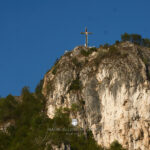
In the afternoon we arrived to the Monastery of st. Nikolai, which is situated at the foot of the Sokolske mountains. On the peak of the closest one, from the last photo in the previous set, once stood a formidable castle Soko Grad, which is the only one that had stood untouched by the Turks. I don’t know why the castle is no more, but on its ruins now stands a huge cross, which signifies the importance of Christianity in this area.
The very next morning Matjaž and I chose to wake up early to hike up the mountain. I think we started at around 6.30 AM. It was a beautiful fresh morning, not too cold though. First we made a wrong turn and ended up at the small waterfall nearby. It was still a beautiful sight. Alas, we turned around and took another route. We soon found a small shrine with the first commandment from the Decalogue and as we continued found another and another.


The last one was not fully on top but just before the once huge entry gates of the Soko Grad Castle. There was also what seemed an abandoned house, a water fountain and some wooden barracks. I ought not forget the strange sight of a phone-box in the wilderness. We continued up the hill on the ancient cobbled road, that lead through the castle gates up to the peak with the cross. Of course the path is safe with some metal stairs and railings just under the peak.
But the view. The view from the top was breathtaking. One one side you could see the mist rising from the Drina river and the Bosnian mountains beyond. On the right you could see the tiny village on top of the other side of the mountain range, with farmers already working. It was so picturesque. With flocks of birds, presumably pigeons, freely flying around in the nature, the likes of which I have not seen in Slovenian wilderness before, and the tiny old village as a backdrop, it really felt like I was transferred back 100 or 200 years ago, as if ti were on an old painting. It really was gorgeous. And then I realized that I stood on the top of the mountain where there were ruins of a castle all around, built on top of a jaw-dropping cliff-side. Those people really were crazy.


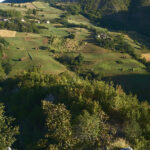


Up on the mountain Matjaž and I prayed and read a Psalm. It’s always nice to start the day with the scripture. Especially since going up the mountain meant missing the first morning prayer in the orthodox church in the monastery.
Going back down I took some photos I had forgotten to take earlier, and used my 50mm f1.7 Minolta MD lens (earlier I just took photos mostly with the 15-50mm Sony stock lens). The views were due to the change of light different but still amazing and looking at them, I hope you agree with me, that they truly were.


Every day in the morning we had Taize prayer as well, but with the exception of the last day I completely forgot to take a photo of that. I was so transfixed with the beauty of Taize-style prayer in the songs, with this type of worship, that I had completely forgotten about everything else around me.
After Taize and some break we had Bible Teaching, which you can take as a lecture, as a sermon or what-have you. The message of this week revolved around Jesus in the Gospels. Basically, through the entire week and all the messages we explored, what Jesus means for every single one of us here and now. And equally the dangers of established orthodoxies of “faith” which can very swiftly take one away from the experience with God. One of the messages for example revolved around the Prodigal Son parable, where we often forget about the meaning of Father and His heart in the matter, and how we often forget about the older son, who we often, as Christians, embody in orthodoxies. We often also talked about how Jesus really was a builder of a kingdom different from these of the world. Here I don’t mean merely how we are to serve, instead of being above and let us be served (which rulers today, and ever, demand). Here I mean, what N.T. Wright suggests as well, that to follow Christ means radically following Him not only as my Saviour, but as my Lord and ultimately King.


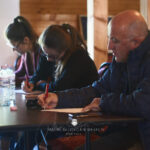
The continuation of Tuesday resulted in a short hike to the waterfall with Boštjan, Eva, Janja and Nastja. You guys are awesome. I really enjoyed spending the time with you.


Somehow this week I was at the right place at the right time all along, since I got to see places I might not have seen otherwise. Thus Matjaž invited me to go see a monastery several kilometers away with a few other people, among which were also two really funny guys, Damir from the Croatian Bible Society and Petko from Macedonian Bible Society (I think). I had a blast chatting with them in the car. Anyhow. I can’t recall the name of this monastery we went to that day. It was one of the many monasteries in Serbia today, which are growing and this one was being remodeled. You see, Orhodox church doesn’t require celibacy for most positions in the Church hierarchy and thus the movement is growing in Serbia, unlike catholic Europe which is either stagnating or even declining, partly due to celibacy as a requirement for priests.


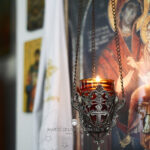


At that monastery we also met this interesting man of God. It was an interesting experience, the old man was, almost surreal, like he was taken from one of those old Dostoevsky novels.
[Read the entire Photo Journal here]