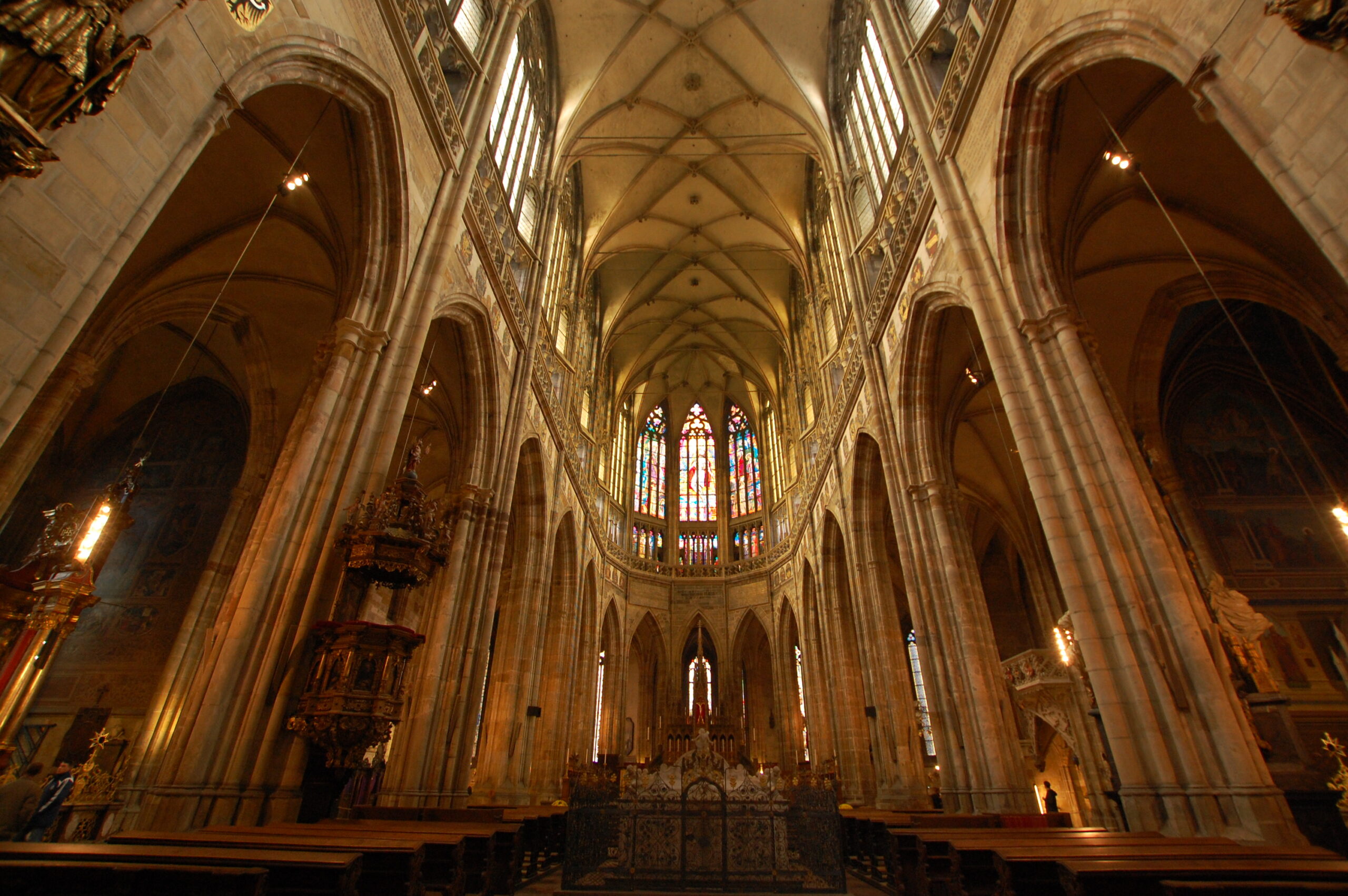
I grew up a Catholic. My parents took me to church every few Sundays. Not every week-end though. I was made to go to the sunday school, that is in my language actually called something like “Faith Education.” I didn’t really believe in God that much back then. After Confirmation my path with Catholicism somewhat ended.
In the last years of elementary school I was introduced to English Camps and thereby to evangelicals. With that came scientific and philosophical tendencies to figure out the reality. Cosmological argument kind of proved to me, that God exists. And with evangelicals, I somewhat liked the idea of a personal God, with whom people can have relationship as opposed to Catholic upbringing, which pointed to a distant god that doesn’t really care that much. It’s not only that I liked the idea about it, the more I thought about it (and I do tend to overthink things), the more it made sense.
How can a God create a world and creatures that are more than just computers or animals. How can He not be somewhat involved with His creation? Moreover if God creates, the creation can only reflect what that entity knows of. Therefore a polytheistic multitude of gods can only know hierarchy and not a loving relationship, moreover a one-personal god cannot know of any relationship whatsoever and the only God who can create a world with creatures such as our own who can know of love, and personal relationship must be more than God one person. And the God of Abraham, Isaac and Jacob of the Bible is not only one person, but Father, Spirit and the Son, three in one. And the creatures that He creates, He wants to be in relationship with, without force, coercion and compulsion.
Due to this I could not be in the Catholic Church any longer. Partly that is because I didn’t learn of this through the liturgy or any other means of tradition nor Sunday school. Without substance of a personal God all of tradition for tradition’s sake, and all of the teaching was in vain. Just like in school, it matters not what teachers teach you or make you learn, because you forget most of it. What stays is what makes a difference and what makes you ponder, and most often when they are personal. The Catholic Church and its ways were not personal. At least not to me. Catholicism to me seemed monolithic, harsh, brainwashing, something made for stupid and dumb people. It lacked substance.
For some years then I hung out with evangelicals. There was joy, personal God, direct prayers. That’s another thing. In the Catholic Church it had always seemed strange and sometimes even frighting how people prayed as with one voice and never even considered the words that they knew by heart. And honestly I still consider repetitive tasks like these very dangerous. People don’t even think about what they are talking about, they don’t ever register their words. Some probably might, but most don’t. Sometimes when I reflected on it all, it seemed as though people in church often looked like those peoples in the movies who, brainwashed, bowed down before a false deity, or like people who obeyed every order decreed by Hitler and his lot.
Evangelicals didn’t seem like that at first. In most churches, I visited, people were genuinely interested in you, or so it seemed, and they seemed to genuinely worship God without being brainwashed.
In the midst of all of that, I had been reading a lot and slowly I picked up not only the Bible and evangelical literature, but also Church Fathers and even some later texts, like late scholastics and even writings of Catholics of later periods. There’s a wealth of knowledge and good Godly biblical literature around it. And only if I am not selective in my readings, can I be intellectually honest with myself and others. I have since found many good reading on both sides. Now when I think about it, Catholics could learn a whole lot from Protestants, and vice versa.
Earlier I was taught that one should never add to the gospel or remove from it and that salvation was only in Christ. You know the protestant pleas: “Sola scriptura (Scripture alone) Sola fide (faith alone), Sola gratia (grace alone), Solo Christo (Christ alone), Soli Deo gloria (to the glory of God alone),” or commonly known as Five Solas. Sola Scriptura meaning that the only authority is in and through the Bible, not the Pope or tradition, and therefore all traditional and extra-biblical was to be rejected. Further Sola Fide emphasizes salvation as a free gift, that salvation can be obtained by trust (faith) alone, not through indulgences that the Roman Catholic Church had been seeling before reformation, but by a trust or faith by individual into Christ. This in effect also nullified works based salvation doctrines of the Roman Church. Sola Gratia emphasized grace as the source of salvation, which is not based in what we do, but what God had done, as Ephesians 2:8–9 teaches: “For by grace you have been saved through faith. And this is not your own doing; it is the gift of God, not a result of works, so that no one may boast.”The reformers also stated, that Sola Christo was immensely important, because only through Christ can we come to God, not through mediation by priests and Pope that Roman Catholic tradition had established. Finally Soli Deo Gloria emphasizes the glory of God as the goal of life; that instead of striving to please church leaders and tradition, we ought to glorify God (and enjoy Him forever).
This is all well and all, but misses intellectual honesty of those who didn’t practice Christianity to the glory of a man-made Institution, but to glorify God. Sure, some church fathers are actually taught in the evangelical seminaries, but too often not much more.
Then one day I stumbled upon Archbishop Fulton J. Sheen. I went on Archives.org and grabbed a text titled “These are the Sacraments,” and just for the fun of it chosen to do the page layout thereof. While doing the rough break, I did notice that his theology was quite sound and that his reasoning behind sacraments was nothing I have ever read or heard before. So I read it after I did the Page Break. They were often not conceptualized as something that was a prerequisite for salvation but rather as a result of it. Further, some sacraments, like confirmation for example, were meant for completely legitimate reasons of confirming people that they are actually walking with Christ. This does resonate with me today, because as among evangelicals, as well as catholics there’s quite a few hypocrites and it is sometimes difficult to know, who is saved. Not that anyone really would know it for a hundred per cent, but if those who walked with Christ were confirmed by their mentor, priest, pastor, etc., it would have been much easier for everyone else. But we all know the story. Sin gets involved and good ideas are turned into absolutes first, then into traditions and when a tradition becomes tradition for its own sake it becomes meaningless and empty. It looses it’s substance. The Christ was supposed to be the substance; when He is gone from the message, may it be a tradition, a speech, a book, or whatever, and when something other than Christ becomes the absolute, we are in trouble, we are in sin.
Now when I look back into the history and see how the good news of Christ has been abused and reshaped into mere traditions, I cannot help myself but wonder why and how. What was the origin and the meaning of those? Fulton has revealed some insight into the sacraments, like the aforementioned confirmation. And what a shame, isn’t it. Catholics often practicing traditions without the substance of Christ and reason, which in effect made it worse for themselves and evangelicals as well. Evangelicals for example have so trampled on the idea of a confession before a priest, that people often walk alone with their troubles never being able to talk about them with another person, may it be a priest, a pastor, a youth worker, a minister or whoever. Sometimes not even with a psychiatrist. Dealing with confessions, not necessarily as a mediator, ought to be in the pastoral job description, right? And yet the basic meaning and use of confession has been skewed on both sides to this day.
You see, if the Roman Catholic Church in certain times hadn’t held the State like powers, and if the message of Christ, the Good News, would not have been so abused, what we call tradition might not have been a tradition but a way of life, as it sometimes in the past was (for example christian celtic Ireland, or pre-4th century christianity, etc.). Yes, indeed, Christianity ought not be a tradition per se, but a way of life.
Furthermore habits and traditions hold something sacred that evangelicals have often forgotten. It’s not only theological factuality that is of concern, but also the mistery of the sacred in action, a song, a hymn, a prayer, even one unified by the congregation with one voice. Yes, there is a place for all of that.
Then there’s another thing. Lyrics in today’s Evangelical Christian songs are often (not always) very shallow. They seem to want to be pop and cool, but again lack substance. They often make you feel good, and the beat is often just right to give you feelings in your body that to some feel like a “spiritual chill” or something. Granted, when all sing together it does feel connecting, and to some odd. Some say that “[evangelical] music is a joke, and who really sings like that?” and I wonder what a seeker or a non-believer would say when encountering a modern evangelical megachurch setting. Message could often sound more like a a motivational speech or blathering in a long way what a verse actually meant. As if it’s so difficult to read the Bible and understand it. When one visits a modern evangelical church, one cannot always spot who’s a liar, who’s a hypocrite, who’s reborn, who’s seeking. Some say that’s ok. But it seems to me, that confusion is not something that is supposed to dwell in a church. Or is our God a god of confusion, shallowness and popular music?
And sometimes evangelical determinism about “sola scriptura” makes people blind to the whole reality. It can lead to the lack of intellectuality, and reason. It can make people go into extremes, where Bible might not instruct them to go to. It can make people deny axioms, mathematical principles, philosophy, even theology to some extent, it can make people deny reality itself. Sometimes it may perhaps make people determine some things to be true due to the incorrect information or even interpretation and hence delude the others. That being said, it might even be tricky to say that, because who’s to say that I’ve seen the whole truth?
I digress. It’s not always that “bad” in evangelicalism, as tradition is not always as “bad.” It’s just a shame that we play on people’s emotions and/or reason to get them to church, but so often forget it’s about relationship with the living God, which is supposed to change you and make you anew. That being said… tradition, music, lyrics, message, preaching, biblestudies, etc. all of that can bring you closer to God when used right and when one already has relationship with God. Or in other words, when it has substance (especially Christ), anything can show you parts of God’s glory. When lacking, anything can take it away. Moreover when without substance it can be very dangerous because it can make people do all sorts of things, to the point of violence, sacrifice and even death.
As for me, I shall not call myself evangelical, nor catholic, but perhaps a non-denominational, or better, simply a Christian. I shall endeavor to follow Christ. Sometimes I might use the word protestant due to my tendency to protest the ways of the world and of set institutions. And in the meantime I will continue to strive to find the joys of old hymns, the glory in chants from monasteries, the beauty in paintings and in whatever I can find, whether God- or man-made that was made to give God the glory and honour that He deserves. Sometimes I might even pray prayers from prayer books, of course directed to God, not my pride in the works of “prayers,” and perhaps even attend a catholic mass (although I admit, that it is still sometimes difficult) every now and then. And even though the church I attend and call my home is an Evangelical Christian Church in Radovljica, I would consider the whole conglomerate of various biblical Christian denominations a universal church, to the glory of God. For it is not the denomination that saves, but Christ.
Traditions are then not necessarily bad. They need not be. Sometimes they are beautiful. When they have substance they can be very healthy and useful. Sometimes they might even lead us closer to God. But always make God first, not a tradition or whatever else. May God be the receiver of the glory, and not an empty “thing.”
Reblogged this on Misijonar sem!.
One note on ‘Sola Scriptura’. Originally, with 16th century reformers, this did not mean a wholescale rejection of tradition, but rather raising Scripture above tradition as the supreme arbiter of doctrine and morals. Both Luther and Calvin and our Trubar were relying heavily (sometimes too heavily!) on Augustine. They held all the church fathers in high esteem.
It was only later, in the evangelical-fundamentalist tradition(!) that all earlier traditions were written off wholescale and the Sola Scriptura acquired the above narrow (and debilitating) meaning.
In saying “or tradition, and therefore all traditional and extra-biblical was to be rejected.” I was somewhat cynically appealing to todays belief about it.
Of course you’re right. Luther obviously, and Trubar too, never wanted to dismantle what was, they just tried to fix the injustices and untruths… reform what was. Not destroy it. But others did.
And that’s another thing… when people hear something and never consult with primary sources, or at least secondary ones, beliefs can develop into untruths. Dangerous thing.